
Bailiff refused to show ID? Know your legal rights
If a bailiff turns up at your door but refuses to show proper ID, they may be breaking the law - and you could have the right to recover your goods, stop enforcement, and claim compensation. This page explains what the law says about identification, what a valid certificate looks like, and what legal remedies are available when bailiffs act without proper authority.
Key Takeaways
- Bailiffs must show ID when requested by the debtor or anyone in charge of the premises under paragraph 26 of Schedule 12
- Failure to show ID renders the enforcement unlawful and invalidates the action taken
- A valid enforcement certificate must be issued by a County Court judge and shown in full on demand
- Using police-like ID or badges may be a criminal offence under section 90 of the Police Act 1996
- Debtors may recover goods and money taken unlawfully and bring a claim under paragraph 66 of Schedule 12
- Fees are not recoverable by a bailiff acting in breach of Schedule 12 or without proper authority
- Evidence such as affidavits and video should support any claim or complaint made
- Post-event ID disclosure does not cure the original procedural defect
- Formal complaints and legal action should be used to secure redress where informal resolution fails
- Enforcement agents may be sanctioned by the court for misconduct or operating without a valid certificate
Refusal by a Bailiff to Show Identification: Legal Consequences and Remedies
Statutory requirement to show identification
It is a fundamental requirement under the enforcement provisions of Schedule 12 to the Tribunals, Courts and Enforcement Act 2007 that a certificated enforcement agent must, upon request, show evidence of their identity to the debtor or to any person who appears to be in charge of the premises. This requirement is enshrined in paragraph 26(1)(a) of Schedule 12, which obliges the enforcement agent to disclose, on request, both their identity and their authority to enter the premises. The request may be made prior to the agent entering or while they are present at the premises, as provided by paragraph 26(2). This statutory requirement is not discretionary. Its breach renders any subsequent enforcement action unlawful and vitiates the legal basis for the agent’s presence and conduct.
Failure to comply renders enforcement unlawful
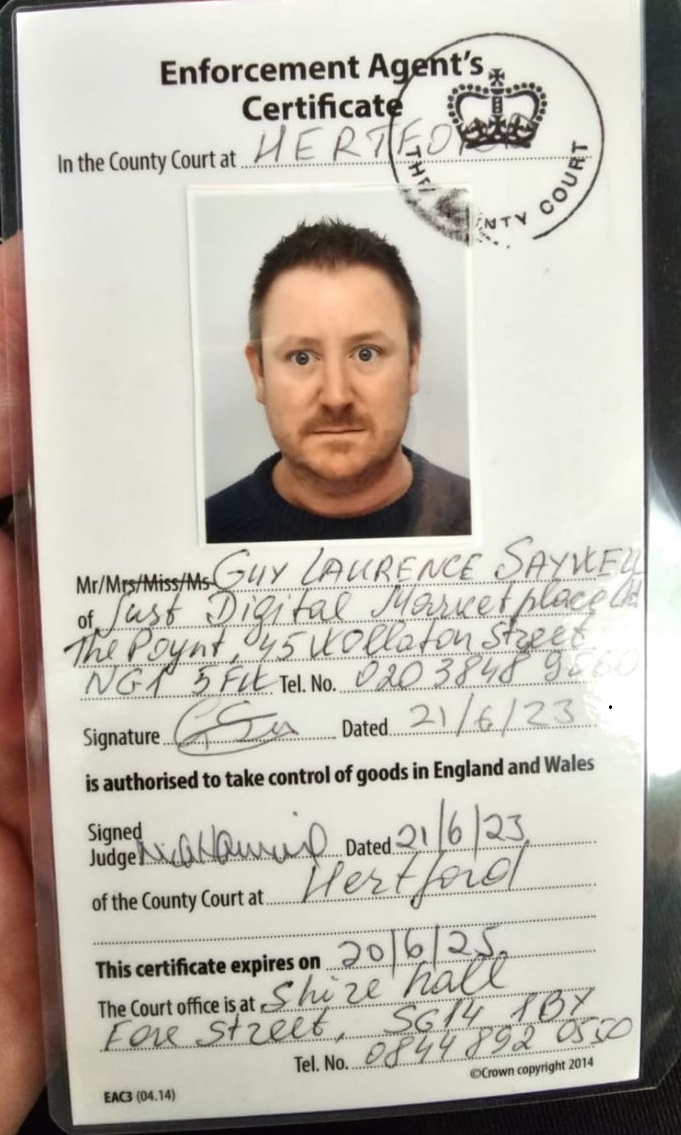
Where a bailiff refuses to show valid identification upon request, he ceases to act within the lawful execution of his duty. The enforcement regime established under the 2007 Act is conditional upon strict adherence to procedural safeguards designed to protect the rights of debtors and third parties. Among these is the obligation to produce, upon demand, the bailiff’s enforcement certificate. This certificate must conform with section 64 of the 2007 Act, which requires that it be issued by a County Court judge and contain the name of the enforcement agent, the issuing court, a photographic likeness of the individual, and the judge’s wet-ink signature. It is typically issued as a laminated card approximately six inches by two-and-a-half inches in size. Any deviation from this format or any refusal to exhibit the same immediately raises a presumption of impropriety and procedural breach.
Use of misleading or unauthorised identification
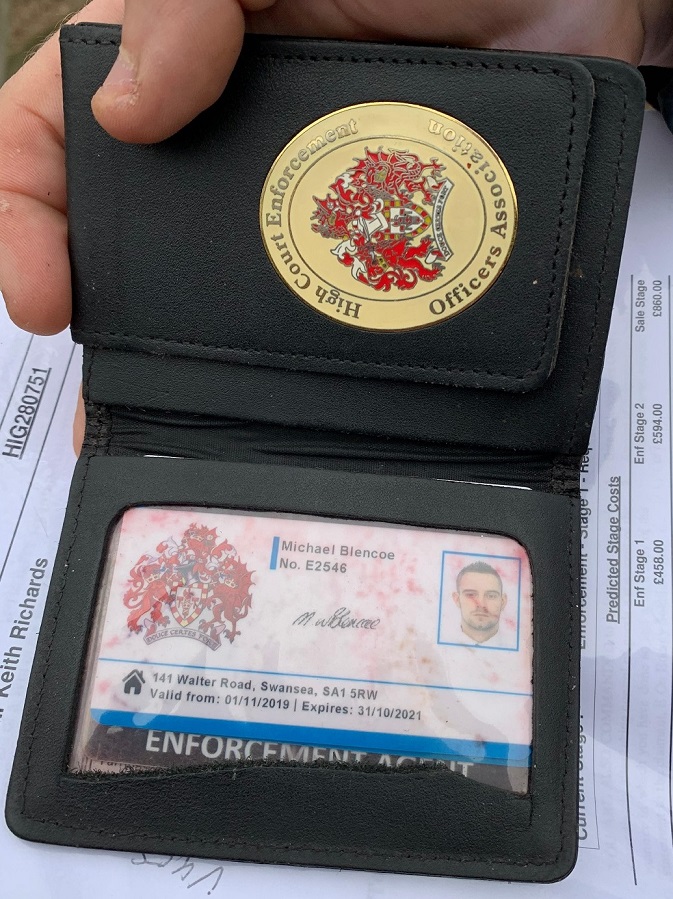
In recent years, there has been an increasing incidence of bailiffs purporting to justify their authority by displaying police-like warrant cards or metal badges which are neither issued nor authorised under the relevant legislation. This practice is misleading, possibly unlawful, and may give rise to criminal liability. Section 90 of the Police Act 1996 makes it an offence for any person, other than a constable, to have in their possession any item of police equipment, including a distinctive badge, with intent to deceive. A bailiff presenting such an item in lieu of their statutory certificate may therefore commit a criminal offence and undermine the entirety of the enforcement action.
Genuine : court issued enforcement certificate signed by a judge
Fake : police style badge or ID is not valid enforcement identification
Legal consequences of non-compliance
The refusal or failure to provide ID at the material time is not a mere technicality. It has substantive legal consequence. Paragraph 66(1) of Schedule 12 provides that where an enforcement agent breaches any provision of the Schedule, or acts under an instrument that is defective, the debtor may bring proceedings. Paragraph 66(5)(a) further empowers the court to order the return of goods to the debtor. The term goods includes motor vehicles and other controlled assets. In addition to the return of such goods, the debtor is entitled to recover all sums paid, including fees, charges, and possibly consequential losses. The failure to comply with paragraph 26 also disentitles the enforcement agent to charge fees under regulation 3 of the Taking Control of Goods (Fees) Regulations 2014, which applies only where the Schedule 12 procedure is lawfully engaged.
Supporting your claim with evidence
Where a debtor wishes to assert a claim under paragraph 66, it is prudent to support the claim by sworn affidavit. Such affidavit should record the precise time and place the request for ID was made, the nature of the bailiff’s response or refusal, and the manner in which the enforcement proceeded thereafter. Where possible, contemporaneous video evidence or photographs of the bailiff’s conduct, body-worn camera positioning, or the use of police-style paraphernalia should be included to substantiate the claim. The court is entitled to draw adverse inferences where a bailiff declines to wear their official certificate openly or relies instead on deceptive substitutes.
Disclosure after the event does not cure the breach
Should the bailiff attempt to produce their ID only after the enforcement has concluded, or retrospectively following a complaint or challenge, such conduct does not cure the original breach. Paragraph 26(2) is explicit in allowing the request to be made prior to entry or whilst the bailiff is on the premises. Post hoc disclosure, particularly when prompted by challenge, is insufficient to restore the lawfulness of an enforcement event already marred by procedural non-compliance.
Available court remedies
In the event of a refusal to remedy the matter informally, the debtor may issue proceedings in the County Court or, where appropriate, in the High Court. The claim may seek declaratory relief that the enforcement was unlawful, restitution of any controlled goods, repayment of fees and charges, and damages for trespass or interference with goods. Where a motor vehicle was removed or immobilised in breach of the Schedule, particularly by night workers relying on automated number plate recognition systems without certification or due authority, the legal basis for enforcement is absent, and damages may be claimed under paragraph 66, possibly including special damages where the loss of the vehicle caused commercial or personal detriment.
Pre-action procedures and complaints
Whilst a formal complaint may be lodged with the creditor, whether a local authority or private claimant, this is unlikely to result in restitution absent litigation or pre-action pressure. It is therefore advisable to submit a letter before action in accordance with the Pre-Action Protocol for Debt Claims or the general pre-action practice direction under the Civil Procedure Rules. The letter should recite the statutory breaches, enclose a sworn affidavit, refer to any supporting exhibits, and demand the return of goods and reimbursement of funds within a fixed period, failing which proceedings will follow.
Sanctions against the enforcement agent
Where the conduct of the enforcement agent includes impersonation, deception, or harassment, or where the agent is known to have operated without a valid certificate or under a suspended or expired authority, a complaint may be referred to the issuing County Court for the suspension or revocation of the bailiff’s certificate under the process prescribed by section 64(3) of the 2007 Act. This is a serious matter, and where proven, may result in removal of the individual from the register of certificated enforcement agents maintained by the Ministry of Justice.
Conclusion and recommended action
To conclude, a bailiff who refuses to show valid ID upon request is not acting lawfully and renders the entirety of the enforcement exercise susceptible to legal challenge. The debtor has several remedies available under statute, including return of goods, recovery of money, declaratory relief, and an award of costs. The statutory regime requires scrupulous compliance with procedural safeguards and affords the court a broad discretion to rectify injustices arising from breach. The protection of these rights lies in the prompt and assertive use of available legal remedies, supported by cogent evidence and sound legal argument.
Remedies
- Apply to the court under paragraph 66 of Schedule 12 to recover goods, vehicles, and money taken unlawfully
- Submit a sworn affidavit to evidence the bailiff’s refusal to show ID and to support any legal claim
- Bring a claim for restitution in the County Court or High Court seeking return of controlled goods and damages
- Challenge the enforcement fees on the basis that Schedule 12 procedure was not lawfully engaged
- Issue a letter before action under the Pre-Action Protocol demanding repayment and return of property
- File a complaint to the County Court under section 64(3) of the Tribunals, Courts and Enforcement Act 2007 to revoke or suspend the bailiff’s certificate
- Report criminal misconduct where police-like ID or badges were used unlawfully under section 90 of the Police Act 1996
If a bailiff refuses to show valid ID when requested, any enforcement they carry out may be unlawful. You may be entitled to recover your goods, money, and legal costs. Keep clear records, take video evidence where possible, and submit a sworn affidavit. If informal complaints are ignored, issue a formal letter before action and apply to court under paragraph 66 of Schedule 12. Always act promptly and seek legal advice to protect your rights.